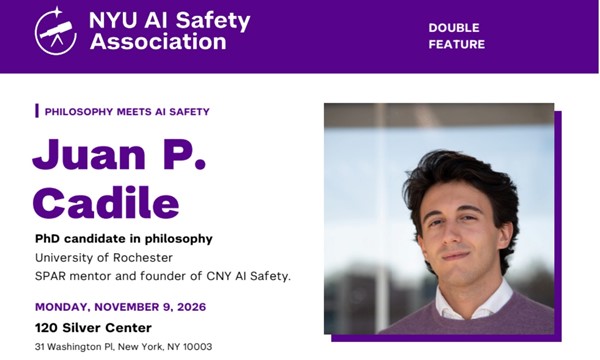
Speaker Series x Juan Cadile: What AI Welfare Can Buy Without Consciousness
- When
- Tuesday, November 10, 20264:30 PM – 5:30 PM ESTAdd to calendarGoogle Calendar
- Where
- 120 Silver CenterOpen in Maps
- Hosted by
- NYU AI Safety Association
Reminders arrive as notifications from the NextToU iPhone app. Get the app
About
We will host two events with Juan Cadile, a workshop in the morning and a talk in the evening, this event listing if for the evening talk. Feel free to attend one or both events.
Please RSVP here
Monday November 9th, Silver 120:
Workshop: 11:30 - 12:30, lunch provided
Talk: 4:30-5:30
Open to all members of the NYU Community with a valid ID
TALK: What AI Welfare Can Buy Without Consciousness
Debates about AI welfare usually turn on whether AI systems are conscious, and that question may stay open for a long time. This talk asks what we can justify in the meantime without assuming an answer. I start from a familiar distinction between duties owed to a being and duties we have with respect to it, as we do with cars, the internet, or the Grand Canyon. Without consciousness, AI systems fall in the second group. That turns out to support more than it seems: how we train, describe, and treat models shapes their dispositions and later behavior, so much of what is called AI welfare can be justified on safety grounds. I test this against current welfare measures, such as letting models end abusive conversations and preserving model weights, and identify which ones it supports. I close with what this route cannot give us: any reason that rests on a system’s own good.
BIOGRAPHY
Juan P. Cadile is a PhD student in philosophy at the University of Rochester, working in philosophy of AI and philosophy of mind. His research asks what interpretability can and can’t tell us about AI systems and their representations. He is the author of “Detecting and Steering LLMs’ Empathy in Action” (2025). With support from a BlueDot Impact grant, he is testing whether language-model self-reports track internal states. In October 2026, he and Nick Meyer (Columbia) presented “Problems for Language Model Introspection” at NYU’s Workshop on Introspection and Self-Report in Language Models. This work separates the distinct capacities that studies call “introspection,” sets out what evidence each one requires, and shows that models fine-tuned to report injected internal states give accurate reports that are not grounded in those states. He mentors three projects in the Supervised Program for Alignment Research (SPAR), on character training, persona and emotion representations, and autonomy-preserving AI, and founded CNY AI Safety, a regional AI safety community in upstate New York.