
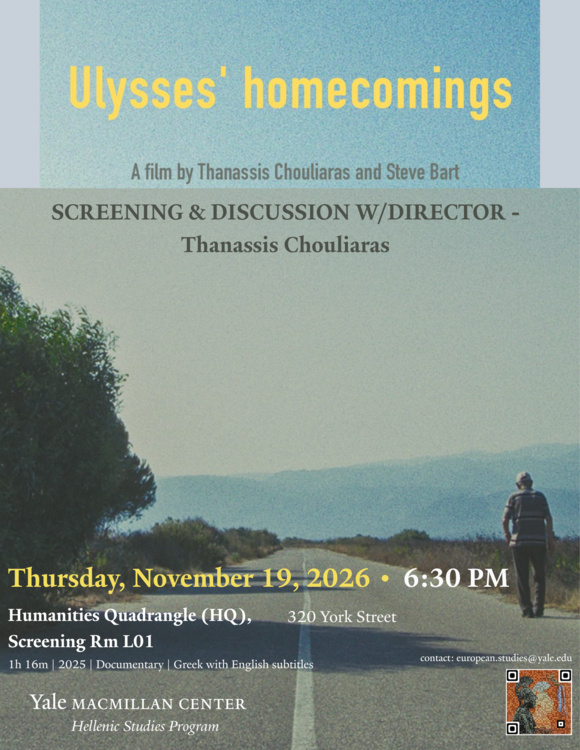
Ulysses’ Homecomings, Hellenic Studies Film Screening
- When
- Thursday, November 19, 20266:30 PM – 8:30 PM ESTAdd to calendarGoogle Calendar
- Where
- Humanities Quadrangle HQ L01, Screening Room320 York Street, New Haven, CT 06511Open in Maps
Reminders arrive as notifications from the NextToU iPhone app. Get the app
About
The Hellenic Studies Program presents ULYSSES' HOMECOMINGS, an exclusive film screening with Thanassis Chouliaras, the filmmaker of
ULYSSES' HOMECOMINGS
1h 16m | 2025 | Directors: Steve Bart and Thanassis Chouliaras | Documentary | Greek with English subtitles
A film by Thanassis Chouliaras and Steve Bart
A road movie that follows the travels of an elderly man from the family's lowland wintering place to his mountainous village of origin. The journey serves as an opportunity for reflection on the passage of time and the end of an era and a way of life that remained unchanged since the Homeric period.
The film is a poetic observational documentary, with my father as the main subject of observation. The latter, born in 1928, lived his childhood and adolescence divided between villages of Fthiotida and Evritania (regions in central Greece), following the family's annual transhumance group movements.
We follow him cinematically on a contemporary return journey to the mountainous Krikello of Evritania. We let him wander and freely recount memories and stories, seeking to capture every aspect of his relationship with the place and the people. The close relationship with the subject of observation, the advanced age and the organic experiential connection with the places create the conditions for the "disappearance" of the camera.
The route, which only to a certain extent identifies with today's road network, passes through villages that retain solid elements of the past. Abandoned houses and fields, traditional cafés and old people become the visual record of a past way of life. The depiction of the natural landscape in its relationship with humans combined with the narrations highlights the thread that connects everyday practices from prehistoric times to electrification; a per se grounding intrinsically carried by the rural way of life, a way of life that, de facto now, is lost in oblivion.
Listening to all these stories during my childhood grew and mythologized this particular route in my mind. After all, these narrations, having as their source the memories of my father, carried the fairy-tale charge that every childhood memory carries. Τheir repetitive “rhapsodic” character allowed me, over the years, to penetrate deeper and deeper into the poetry of nostalgia for the anticipated annual return. In my mind this return, with all the obvious practical difficulties created by the lack of means of the time, was a little Odyssey.