
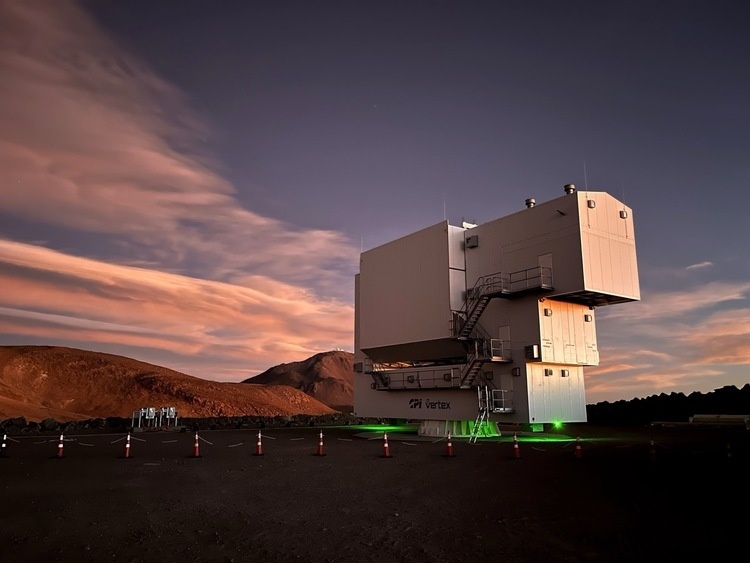
NPA Seminar: Zeeshan Ahmed, Kavli Institute, SLAC National Lab and Stanford
- When
- Thursday, November 12, 20261:00 PM – 2:00 PM ESTAdd to calendarGoogle Calendar
- Where
- Wright Laboratory WLE 102272 Whitney Avenue, New Haven, CT 06511Open in Maps
Reminders arrive as notifications from the NextToU iPhone app. Get the app
About
Talk Title: "Mapping large-scale structure with the Simons Observatory: from multiplexed readout to early science"
The Simons Observatory (SO), now in full science operations in Chile, will drive major advances in cosmic microwave background (CMB) science over the next decade. This talk describes the microwave-multiplexed readout that made SO’s roughly 100,000-detector deployment possible, and highlights preliminary SO collaboration results on CMB lensing that preview the observatory’s 10-year survey of large-scale structure.
Host: Laura Newburgh
Full abstract: Ground-based cosmic microwave background (CMB) science will see significant advances over the next decade from the Simons Observatory (SO) in Chile’s Atacama Desert and the South Pole Observatory (SPO), even though the agencies are not pursuing CMB-S4 for now. SO entered full science operations this fall, and its 6-meter Large Aperture Telescope (LAT) will map about 60% of the sky at arcminute resolution through 2034, measuring how the CMB is gravitationally lensed by intervening mass. Together with the Dark Energy Spectroscopic Instrument (DESI) and the Rubin Observatory, these maps will trace the growth of structure and constrain the sum of neutrino masses and the effects of dark energy.
The survey rests on roughly 100,000 transition-edge sensor (TES) bolometers across SO’s four telescopes, read out with microwave superconducting quantum interference device (SQUID) multiplexing and the SLAC Microresonator RF (SMuRF) electronics. I will describe how this architecture scaled to the 63,000-detector LAT receiver while keeping readout noise a small contribution to on-sky noise, and how instrumental systematics are tested through null tests, including map-level comparisons with the Atacama Cosmology Telescope (ACT). I will then highlight preliminary results from the SO collaboration based on about 180 hours of LAT observations: a CMB lensing mass map over about 600 square degrees, its power spectrum, and its cross-correlations with the other structure tracers. These early measurements preview the 10-year SO survey. I will close with the outlook for inflation searches with SO’s small-aperture telescopes and SPO.