
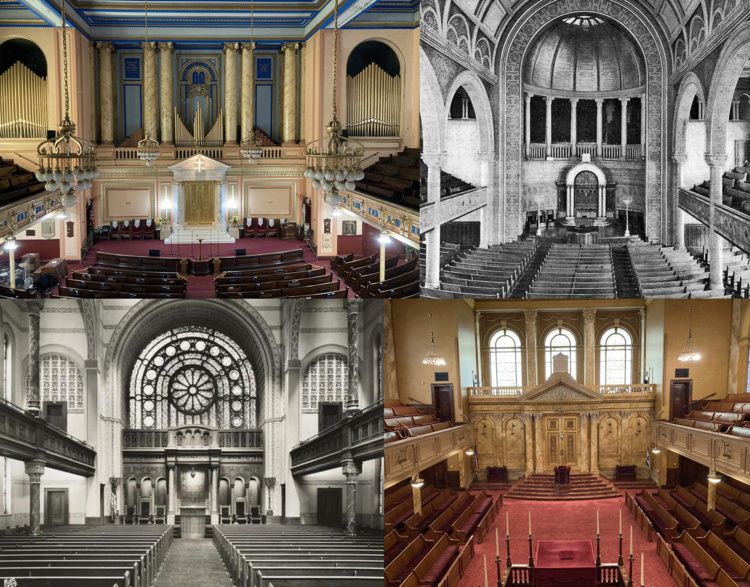
The Acoustics, Architecture, and Use of Three Arnold Brunner Synagogues
- When
- Thursday, November 12, 202612:00 PM – 1:00 PM ESTAdd to calendarGoogle Calendar
- Where
- Miller Hall406 Prospect Street, New Haven, CT 06511Open in Maps
Reminders arrive as notifications from the NextToU iPhone app. Get the app
About
An ISM Fellows Talk with Elliot K. Canfield-Dafilou.
Arnold Brunner (1857–1925), the preeminent American-born Jewish architect, is attributed with designing several notable and imitable synagogue buildings. While some of these synagogues, like the Moorish/Byzantine Temple Beth-El, have been demolished, three of his landmark synagogues remain in New York City today, including buildings erected for Congregation Shearith Israel, Temple Sharaay Tefila, and Temple Israel of Harlem. Brunner's adoption of the Classical style had lasting influence in American synagogue design in the late nineteenth and early twentieth centuries. While the Sephardic community Shearith Israel still occupies their Brunner building, the other two congregations, both affiliated with the Reform movement, have relocated to mid-twentieth century buildings. Shaaray Tefila's former building is now occupied by the Ukrainian Orthodox Cathedral of St. Volodymyr, and Temple Israel's building now houses the Mount Olivet Baptist Church. The use of the space and the acoustic needs vary greatly across these faith traditions. Acoustic measurements of these historical Brunner buildings are presented and contextualized by the changing needs of the congregations that inhabit them. The current buildings of Sharaay Tefila and Temple Israel are also surveyed. Acoustic issues related to sanctuary arrangement and furnishing, speech intelligibility, liturgical and musical suitability, and the use/disuse of amplification are discussed.
This event is free, but registration is required. Lunch will be provided.
Open to Yale Community only. This talk is a part of the ISM's Fellows Lunch series.
Contact: Katya Vetrov
Speaker Bio:
Elliot K. Canfield-Dafilou studies relationships between architectural acoustics and listeners, musicians, and composers. His work is multidisciplinary and frequently combines scientific and creative endeavors. He was a researcher in the Institut Jean le Rond d’Alembert at Sorbonne Université studying the aural heritage of Notre-Dame de Paris. Elliot earned his Ph.D. from the Center for Computer Research in Music and Acoustics at Stanford University with a dissertation on Performing, Recording, and Producing Immersive Music. At Stanford, Elliot was part of the Icons of Sound project simulating Byzantine chant in the acoustics of Turkey’s Hagia Sophia. At the ISM, he will continue the exploration of how the acoustics of sacred spaces affect music and auditory perception. Learn more about Elliot’s work.