
Civil and Environmental Engineering Seminar: From Salt to Sidewalk - Microbial communities in and on concrete (Dr. Julia Maresca)
- When
- Friday, November 13, 202612:45 PM – 2:00 PM ESTAdd to calendarGoogle Calendar
- Where
- Link Hall 369Link Hall, Syracuse, NY 13244Open in Maps
- Hosted by
- College of Engineering and Computer Science (ECS)
Reminders arrive as notifications from the NextToU iPhone app. Get the app
About
Concrete is the most used building material in the world, and thus a widespread habitat. Although it is an extremely harsh environment – dry, hard, salty, and very alkaline – it hosts a small and diverse community of extremely stresstolerant microbes that changes over time. At first, the microbial community is a small subset of the microbial communities in and on the components of concrete, but it changes as the concrete ages and deteriorates, with inputs from natural and anthropogenic sources. Using cultivation and metagenomic approaches, we have discovered that many of the bacteria in concrete prefer ordinary conditions but tolerate a wide range of stresses, and that decades-old concrete also hosts extremely high-salt-adapted (halophilic) archaea. Metagenomic data from road salt demonstrates that the road salt microbial communities are dominated by halophilic archaea, and suggests that surface treatments may actually inoculate roads and bridges with microbes capable of thriving inside the concrete matrix.
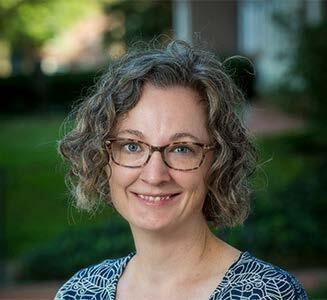
Julie Maresca is an Associate Professor of Biochemistry at SUNY College of Environmental Science and Forestry. She got her BA in Biology from the University of Chicago, and after two years as a postbaccalaurate fellow at NIH got her PhD in Biochemistry, Microbiology, and Molecular Biology at Penn State, followed by a postdoc in Civil and Environmental Engineering at MIT. After 13 years in Civil and Environmental Engineering at the University of Delaware, she moved to the Chemistry department at SUNY ESF, where her research in environmental microbiology uses (meta)genomics, physiology, and genetics to investigate the microbes in freshwater environments (ask me about sponges!), wastewater, and concrete and put them to work for us.